Edgar Andrews’ Onefootinglory Podcast
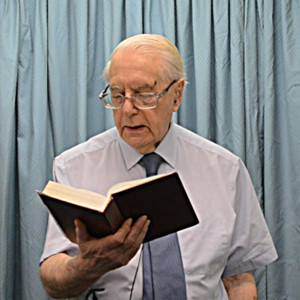
Old men are often said to have ”one foot in the grave” but those whose trust is wholly in Jesus Christ for time and eternity are not looking forward to the grave but to glory, for the Bible says that to be ”absent from the body” is to be ”present with the Lord”. At the age of 87, therefore, I have chosen this name for my new podcast which will feature videos of talks, comments and lectures about the Bible and science and also Bible expositions.
Listen on:

WHAT TO EXPECT
Welcome to my podcast. Both video and audio options are posted for each episode.
Each episode is an expository sermon or Bibe study delivered at the Garden City Church (formerly the Campus Church) in UK at Welwyn Garden City, postcode AL7 3UQ or an apologetics talk or reading from one of my books.
Edgar Andrews is Emeritus Professor of Materials Science at London University, UK and has also published read-like-a-book Bible Commentaries on Galatians and Hebrews and a variety of Biblical apolgetics books including "Who made God? Searching for a theory of everything" and "What is Man? Adam, alien or ape?".
Episodes
Sep 17, 2026
Sep 17, 2026
26 min
This episode expounds 1 Corinthians 1:26–31, explaining that church membership is a divine calling and not a casual hobby. Paul emphasizes that God chooses the weak and the unlikely so that no one may boast, and that Christ is our wisdom, righteousness, sanctification, and redemption. The sermon describes God’s deliberate shaping of local churches to glorify Him, and urges believers to live dependently on God’s grace rather than on human achievement.
Sep 17, 2026
Sep 17, 2026
26 min
This episode expounds 1 Corinthians 1:26–31, explaining that church membership is a divine calling and not a casual hobby. Paul emphasizes that God chooses the weak and the unlikely so that no one may boast, and that Christ is our wisdom, righteousness, sanctification, and redemption. The sermon describes God’s deliberate shaping of local churches to glorify Him, and urges believers to live dependently on God’s grace rather than on human achievement.
Sep 5, 2026
Sep 5, 2026
35 min
This episode explores the parable of the sheep and the goats (Matthew 25:31-46)under three headings; 1) the promise of Christ's return; 2) the problem of works (including empty professions of faith), and; 3) the possession of the kingdom. It emphasizes that the parable predicts a real future judgement and identify true Christians as whose love for one another reveals the reality of their faith.
Sep 5, 2026
Sep 5, 2026
39 min
This episode explores the parable of the sheep and the goats (Matthew 25:31-46)under three headings; 1) the promise of Christ's return; 2) the problem of works (including empty professions of faith), and; 3) the possession of the kingdom. It emphasizes that the parable predicts a real future judgement and identifies true Christians as those whose love for one another reveals the reality of their faith.
Sep 1, 2026
Sep 1, 2026
27 min
In this episode we study Acts 17 and Paul’s approach to evangelism, first finding common ground and engaging in reasoned conversation and then preaching Christ with special emphasis on the resurrection. The resurrection is presented as a powerful, fourfold declaration: it proclaims the deity of Christ, the accountability of all people to God, the justification (purity) of believers now, and the future security of believers in eternity.
Sep 1, 2026
Sep 1, 2026
30 min
In this episode we study Acts 17 and Paul’s approach to evangelism, first finding common ground and engaging in reasoned conversation and then preaching Christ with special emphasis on the resurrection. The resurrection is presented as a powerful, fourfold declaration: it proclaims the deity of Christ, the accountability of all people to God, the justification (purity) of believers now, and the future security of believers in eternity.
Aug 29, 2026
Aug 29, 2026
30 min
Speaking to intelligent but idolatrous Athenian philosophers, Paul starts by seeking common ground by engaging their curiosity about religion, evidenced by their altar to the "unknown god". Having used this to show how he approached evangelising people with no knowledge of Christ, he presents three core beliefs without which there can be no salvation. 1) A triune God created all things by Christ (theism); 2) God continues to uphold and control the world in Christ (in contrast to deism and idolatry); and 3) God will judge the world through Christ. Modern evangelism should return to these foundational truths if it is to succeed.
Aug 29, 2026
Aug 29, 2026
33 min
Speaking to intelligent but idolatrous Athenian philosophers, Paul starts by seeking common ground by engaging their curiosity about religion, evidenced by their altar to the "unknown god". Having used this to show how he approached evangelising people with no knowledge of Christ, he presents three core beliefs without which there can be no salvation. 1) A triune God created all things by Christ (theism); 2) God continues to uphold and control the world in Christ (in contrast to deism and idolatry); and 3) God will judge the world through Christ. Modern evangelism should return to these foundational truths if it is to succeed.